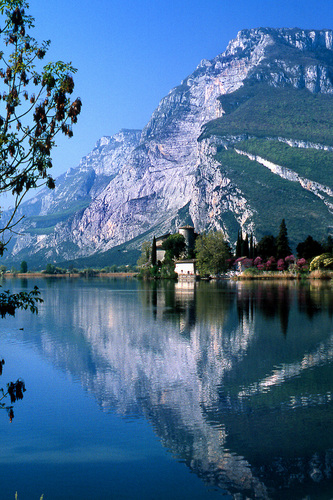
The townof Calavinois a smallvillage in the Lakes Valley in Trentino, that enjoysa goodclimate; the centre is divided in two parts by the maining road; the uppur one has some beautiful building of the Reinassance, while the lower part has medieval origin and you can find there some mills. Calavino is known because is close toLake SantaMassenza;for CastelToblino, being surroundedby waterof the lake; for Nosiolawineand“vin santo”; for the beauty of the landscape, just around the centre there are vineyards and orchards.In this particularnatural environment you can domountain-biking,hiking, rock climbing.
Castel Toblino
TERRITORY
Province: Trento
Fractions: Sarche
Neighboring municipalities:Drò, Lasino, Lomaso, Padergnone, San Lorenzo in Banale, Trento, Vezzano
Calavino lies in the Lakes Valley in Trentino, on the slopes of Monte Bondone, at 409 meters above sea level and extends along the river Roggia, which descends from the village of Lasino and is fed by spring water Buss Foran. Mas, Bagnol, Casal, Piazza and the four districts that form the town. The climate is mild due to the neighboring lakes and the proximity to the lake of Garda, the crops are olives and vines.
Sarche: remains on the crossroads between the Caffaro main road and the road to the lake of Garda, downstream and close to the lake from Calavino, at the beginning of the gorge at the foot of Monte Limar Garzolet (971 m).
Lagolo: it is a small fraction that remains above the rising Calavino Bondone, is known for its lake (929 m) swimming, thanks to its gentle shores and quite popular.
HISTORY
The inhabitants of Calavino at the beginning lived by hunting and herding, only with the passage of time wrestled in the art of farm, moved to the bottom of the valley called “Campagna” where the river Roggia flowed, which descends from Lasino and taken the current way only later because of the floods. Here they built houses made of wood more comfortable and stabilize the land. In Calavino the Romans arrived between 200 and 100 BC, organizing with roads that were then the trace of the modern way of communication.