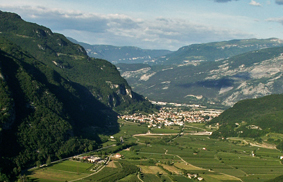
Tierno: At the foot of Monte Baldo is the hamlet of Tierno, which has about 1000 inhabitants. In locality Coste, bordering the town of Brentonico, you can see the remains of the castle “Castel Palt” Tierno is also famous for the “Grand Carnival” that attracts a lot of people, also for famous “bigoi co’ le sardele” that are distributed with the occasion.
Mori Vecchio: Mori Vecchio (Old Mori) is a small hamlet that is west o the center of Mori, along the valley of the Rio Cameras.
Varano: From Valley of San Felice you can reach Varano which now has 49 inhabitants and is the smallest fraction in Gresta Valley. Varano is an ancient village; in 1234 the family of the Lords of Gardumo asked and obtained from the Prince Bishop’s permission for the construction of a castle on the “Grom“, probably the ruins that we found today, in 1339 Varano had surveyed 18 fires (families) and then thanks to this substantial presence, it could create their own Municipality, so that even now though it is a small village there are four groups, one of which, “Arche”, had once buildings with large arches on the ground floor, now closed, here is possible to see a building with a mullioned window of 1877 decorated with a mask and surmounted by a mustachioed character in female dress.
Pannone: was the place of the municipality of Gardumo until 1971, now divided between Mori and Ronzo-Chienis. Located on Volture plain is famous for its organic farming, is at the center between the high and the low valley and consists of four blocks. The Great War has seriously damaged the old city center that was completely demolished to make way for a large square surrounded by houses, using the stones of the fort of Dosse. But despite the destruction you can still see the old houses as the canonical, home of the vicar of Gresta; the houses of Martini and among them, the building that was used by Castelbarco as a warehouse for the crops of the valley; the old houses of the “Contrada dei Molini” you find along Rio Gresta. Although the river has ever had great importance for the economy of the valley and was witness to the presence of some mills and sawmills, now remains the “Pont del Molin” that is located in the valley, a stone arch bridge and a source with hammer is still functioning.
San Tomè: Its name derives from ancient Romanesque church of St. Tommaso, today there is not much of the old houses of the past; There are still here the “Casa Rossa” (red house) and some others that have been refurbished to form the resort of San Tome. On the ridge of Monte Creino down to Nago and Lake Garda is the church of St. Tommaso, surrounded by orchards and vineyards, this church is all that remain of an ancient country that is said to have been destroyed by a landslide. Built with square stones, has walls dated back to the thirteenth century, although during the excavations were found the remains of a much older building. It was also found a tomb dating back to the eighth century AD It has recently been renovated thanks to the National Association of Alpine section of Mori.
Nomesino: From Valle San Felice, by a road that climbs through terraced fields we get to Nomesino, a hamlet of a few hundred inhabitants. Its stone houses with wooden balconies, stairs and large roofs make it a very picturesque mountain village. This country was already inhabited during the Bronze Age, which was settled in Roman times as a “gens Numesia“. Various artifacts have been found on the hill of Castel Nomesino, including the grave of Emilia Maxuma, this castle belonged to the branch of Castelbarco-Albano and within fifteen people lived, was destroyed in 1440 by the Venetians. Few remains of another castle were on the road that leads to Lenzima, it is Castel Verde. Nearby you can also admire the votive chapel of San Rocco, built in 1856 during the outbreak of cholera and destroyed by the First World War, was rebuilt in 1926
Manzano: On the road already existed in Roman times that connected Nago to Isera in Vallagarina you find Manzano, a village made up of two centre that are located at the edges of terraces sloping amphitheater formed by dry-stone walls. Even here you can see the volcanic tufa stone houses with stone or wood architraves windows, wooden balconies and some with external stairs. Many of these houses have deep porches with short paved and enclosed by protective walls. Among the buildings that you can see, palace Vittori, a building with a large courtyard and an arched doorway which bears the date 1791. Destroyed by the war has been rebuilt and is now used in the home office. To the east is the church of Sant ‘Antonio Abate dating from the fifteenth century, although the form that we see today and the nineteenth century. There are some shrines, one dedicated to San Rocco and another to Santa Barbara. Do not forget, a bit isolated, church of Santa Appollonia stone made and with a sloping roof covered with stone slabs.
Corniano: Corniano is a ghost town near Manzano, was included by the Province of Trento in the list of places of monumental interest, even if you are arriving in Corniano will be faced with a country completely abandoned, perhaps because of Venetians retaliation in 1440, destroying the castles of Albano and Nomesino, or perhaps because of the plague of 1630, the fact is that although there is no human presence, stone houses, the ruins of the church of S. Agata and colored rocks that overlook the town which gives it a mysterious and fascinating at the same time. The church of S. Agata is styled medieval, Romanesque structure with a pitched roof, has small windows above the portal and apse, a massive tower of stone covered by a spire. Inside you can admire the “Ultima Cena” (last dinner) painted in 1537, is not well preserved and a Madonna with saints. These works have been performed by artists who in the sixteenth century frescoed most of the churches of the Val di Gresta. This was also a holy water stone with engraved patterns which is now preserved at the Diocesan Museum of Trent. The circular apse of the former church was found with the excavations that were carried out in the seventies along with an antique door with two splayed windows. Found many tombs in the churchyard sign that the church had a graveyard.
Valle San Felice: From the historical point of view Valle San Felice was the most important, as the place of the ancient parish of Gardumo that included all the villages in the valley. After the First World War was marked by the road that drive from Loppio to Gresta Valley and in 1922 this arrived to Valle San Felice. Another stump was built in 1930 up to Pannone, it was in 1947 up to Ronzo and only in 1952 the road was finished with the section between Valley San Felice and Nomesino. The town is dominated by the parish church, isolated from the town, which is composed of different centre. To the right of the Rio Gresta we find Ari with the church of S. Anna, then Ambrosi, Finoti, then the group of houses between the square and the river Gresta. The stone houses with balconies and large half-timbered galleries, mingle with rustic buildings of the XVI, XVII and XVIII century and the stately homes of the square, decorated portals with the dates of construction (1583,1765, 1819) with wooden balconies and loggias with stone columns. The palace of the eighteenth century we see was the residence of Castelbarco, it was burned in 1703 by French troops leading to the complete destruction of the archive that was an indispensable source for the valley. It was then rebuilt with current forms and completed with a painted sundial with the words “and here comes and dies the sun” and a portal with pillars topped by stone baskets of fruit that perhaps came from the ancient bell tower of the parish church. There are other buildings to visit as a drying former tobacco and “Molin” an old mill on the river Gresta that belonged to the lords of Gardumo and then to Castelbarco, who held it until the sixties. Inside there are frescoes depicting the flood of 1882 that took away the bridge. At the end of the village is the church of S. Anna, in Gothic style despite being renewed maintains its front where open the door and two side windows and an oculus. Inside the fresco depicting the Four Evangelists and angels bearing the instruments of the Passion, this is a work that dates back to the early sixteenth century. In the nave there are two other paintings in tempera as the altarpiece are due to Enrico Less.
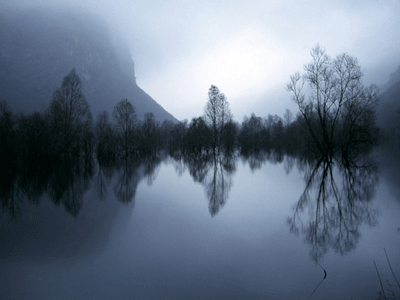
Loppio: Close to the Palace of the Counts of Castelbarco stood the houses of the farmers and employees who worked for them, it was this units to give rise to the village of Loppio. The big house that we see in front of the palace was built in the nineteenth century and housed about twenty families of Castelbarco settlers who first lived in dilapidated houses with no water. This building was called “the factory” and here the settlers could live a healthier life with better hygiene conditions. At the foot of Bordina we can see the remains of another farmhouse that of Cittarini which was destroyed during the First World War. Loppio was also known for its lake but was drained when it was built the tunnel Adige-Garda in 1958, besides Loppio had the loss of the lake, in the First World War the destruction of the palace of Castelbarco and of the arks castrobarcensi, which are monuments of Gothic sculpture in Trentino. Lake Loppio was larger, it was from the San Giovanni crossing to Mori, this until the sixteenth century, then with ducts and control of water in the eighteenth century it greatly reduced the proportions. The lake had many coves and some islands, such as the island of St. Andrea, where recent excavations have brought to light evidence of barbaric and early Christian era. Destroyed during the War of Spanish Succession by troops of General Vendome. Of the beautiful residence of Castelbarco remains about nothing, this building was rebuilt in 1715 and extended in 1812 using the materials that came from the dismantling of the castle of Avio always owned by the Castelbarco, at the end of the work the result was a large L-shaped building on shores of the lake, had long rows of windows and more than sixty rooms. Around the building there was a large Italian garden full of statues and where there was an octagonal artifact named as the “Coffee Haus” which was connected through a channel with a trap for eels, which fueled a thriving fishing trade. In 1980 this building collapsed. With the First World War, the Austrians destroyed the palace and with it almost of the entire historical archive; was saved just some parchment. Today what remain of these ruins are: foundations of the palace, the current home of the Castelbarco, the long building toward the mountain, the garden that has been completely redesigned and a large niche that maybe once housed a statue of Hercules. Near the palace is the church of SS. Name of Mary which was rebuilt in the early nineteenth century, neoclassical style has a single nave and a front with a pediment supported by four columns, we see the bell tower was built in 1856 and is based on dozens of stakes driven into the ground.
Besagno: in the south of Mori we find Besagno with Roman origin, is located on the slopes of Monte Baldo in a dominant position on the plain between Mori and Rovereto, is surrounded by fields, vineyards and chestnut trees. This town has managed to save its three original centre with rustic stately homes, porches and courtyards enclosed by walls. To visit in Besagno there are the church, dedicated to the Presentation of the Blessed Virgin Mary; Boschetti house that is a mansion of the seventeenth century with a rusticated portal with an elegant stone mullioned window, a beautiful fresco on the front of Girardelli house dated 1406 to remember the peace between the Venetians and Castelbarco; the Crucifixion with the Virgin and St. Giovanni the Evangelist, in a newsagent on the front of an old house in the square Castelbarco, this fresco is perhaps one of the most important Gothic Trentino and is derived from Crucifixion painted by Giotto in the Scrovegni Chapel in Padua.