(former Union of Municipalities of Ledro) was established on 1 January 2010,
bringing together the six former municipalities of Pieve di Ledro (chief town), Bezzecca, Concei, Molina di Ledro, Tiarno di Sopra and Tiarno di Sotto; is then part of the “Community Alto Garda Lake” (Arco, Drena, Dro, Ledro, Nago-Torbole, Riva, Tenno).
The main road through the valley from east to west, reaching from Riva del Garda and touching, in sequence, Biacesa, Pré di Ledro, Molina di Ledro, Mezzolago, Pieve di Ledro (chieftown), Bezzecca, Tiarno di Sotto, Tiarno di Sopra, along the lake Ampola and then Storo; from Bezzecca start the branching of val Concei to Locca, Concei, Lenzumo. This road was once one of the main ways of communication between the valley of Churches, Lake Garda and the Adige valley.
TERRITORY OF LEDRO
Province: Trento Ex municipalities (Union of Municipalities of “Valle di Ledro”): Tiarno di Sopra, Tiarno di Sotto, Bezzecca, Concei (Locca – Enguiso – Lenzumo), Pieve (Pieve e Mezzolago), Molina (Molina, Legos, Barcesino, Prè e Biacesa)From 2010 Municipality of Ledro Fractions: Tiarno di Sopra, Tiarno di Sotto, Pieve, Mezzolago, Bezzecca, Concei, Enguiso, Lenzumo, Locca, Molina, Biacesa, Pré, Legos Surrounding municipalities: Storo, Bondone, Condino, Cimego, Pieve di Bono, Bleggio Superiore, Fiavè, Tenno, Tione di Trento, Zuclo, Magasa (Bs), Riva del Garda, Limone sul Garda (Bs), Tremosine (Bs)
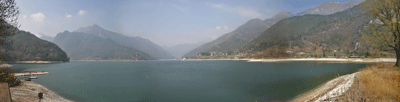
Ledro valley is well defined in its territory between the Valle del Chiese west, Mount Stivo north-east and the Alto Garda Bresciano Park on the border with Lombardy to the south, in the center there is Lake Ledro of little depth but with its characteristic blue color, powered by three inlets and one outlet that feeds the hydroelectric plant of Riva del Garda, the main access to the valley are from Riva del Garda through a tunnel of about 3.5 km or Storo moving from gorge of Ampola. The valley is at an average altitude of 655 meters above sea level with a fairly mild climate, which varies depending on the proximity to Lake Garda, which becomes the alpine type inward towards the Passo Ampola it is a wilderness, covered largely by coniferous forests, fir, larch, poplars and pines, while over a thousand meters pastures are rich in herbs and medicinal roots, several varieties with flowers of protected flora, is also varied and rich wildlife of the area, chamois, foxes, squirrels, weasels, wild cats, martens, grouse, pheasants, eagles.
Ledro fractions: Bezzecca – Concei – Molina – Pieve – Tiarno di Sotto – Tiarno di Sopra
Bezzecca
The village of Bezzecca, in Ledro Valley, derives its name from the fact of being separated into two by the river Assat, creating the town of Villa and Lutta. His name appears in history is during the third war of independence during the First World War, the first time when Garibaldi, who was fighting the Austrians here, received from Vittorio Emanuele II ordered to leave the Trentino and he answered with the famous “I obey”, the second when the country again became Bezzecca war front with the Austrians and always were dug trenches and tunnels of hill St. Stephen who still remain in the memory of those times. In the town center there is a small “Garibaldi Museum” in which they are exposed memories of the battle of Garibaldi and the Great War, always in the center is the church of SS. Stefano and Lorenzo the mid-nineteenth century has replaced the hill of the same name St. Stephen, certainly predates the sixteenth century, another church of interest is that of Saint Lucia in Pratis located along a detour of the road that leads Bezzecca to Tiarno, building with three bays of original Gothic style of the first half of 1300 where a few years ago have been discovered frescoes.
Val Concei(Locca, Enguiso, Lenzumo)
Val Concei runs transverse to the main valley starting just before Bezzecca, where the road is channeled along the valley to reach countries of Locca, Enguiso and Lenzumo, the valley is surrounded by mountains that reach two thousand meters and is crossed by the river Assat which then passes to Bezzecca and joins the river Massangla. Interesting that the name derives from the Latin Concei “Concilium” that in the third and fourth centuries AD was the institution that administered the “Plebs Leutri” (population of Ledro), taking into account that the val Concei passed an old Roman road that connected Riva del Garda with the valley of the Churches through the hamlet of “Campi”, in fact there were various findings of Longobard as a cemetery in Lenzumo and tombs in Enguiso and Locca.
Molina di Ledro
Molina comes from Latin and means “land of the mills,” which were in fact abundant along the sawmills until the ‘opening of the tunnel that brings water to the hydroelectric plant effluent Ponale of Riva del Garda. With the First World War all the villages in the valley suffered a lot of damage because of the bombing, however Molina old quarters still retain the marks of a long building, the oldest is Verdesina, then there are those of Legos, Prè, Biacesa. Visiting the village, you can see the church of S. Vigilio and S. Francesco of Pula, is the first of the eighteenth century and took the place of the same name to the lake, the second in the district is Verdesina the seventeenth century, then continue with some historic homes which house Molina “Demadonna“, which seem to have inhabited Scaligeri in the fourteenth century and home “Zecchini” birthplace of Andrea Maffei, classicist and renowned translator of texts, the frescoes of 700 out of the house “Castel” and home “Bai“, the first depicting a Madonna with Child and saints, according to an “Addolorata“. Definitely do not miss a visit to the Museum of Piles, founded in 1972 after the discovery of more than 10,000 poles and various objects made of bone, pottery, bronze, wood and stone of the Bronze Age
Prè
Pré is a small town which takes its name from the fertile fields which surround him, coming from Riva del Garda is located near the beginning of the valley but taking a detour because the road passes outside the village, as desired by the inhabitants at the time of its construction. Very special is the fact that, because of its particular position relative to the upstream Carone remained for three months a year in its shadow, without direct sunlight from November 11 (San Martino) to 5 February (Sant’Agata), so much so that on his return is celebrated the Feast of the Sun. Ledro valley was known until after the second World War for the quality of its spikes of the inhabitants of the Prè were skilled makers of nails, was an ‘important activities which has remained in the memory of “Fucina de le Broche” (the forge of nails) place having forge and tools where once the nails were prepared for the sole, art that is now being shown to tourists by appointment. Another interesting place is the church of San Giacomo Maggiore, built in the sixteenth century as a chapel, but since the next century elaborately staged, to see the three entrances with stone portals and the frescoes of which is covered inside.
Pieve di Ledro
The name of Pieve immediately recalls the rule that the village had in the history of the valley, its central location and lies on the banks of the lake meant that here was centered religious life, political and administrative rules of the territory in fact, resided here until 1537 religious college who had the task of following the entire population of the valley, using the collegiate church of the Annunciation, certainly dating before 1235. In the town are near the church of the Oratory of S.Giuseppe, consecrated in 1633 and located on the ground floor of the Town Hall, a building documented since the second half of the fifteenth century. Another interesting place is the museum of Pieve “Memories and objects of a tradition – A. Foletto – Stills, Pestles, Cars“, a collection of objects and furniture that the family of the pharmaceutical Foletto has recently set up, dedicating to it some of their nineteenth-century local pharmacy. Leaving the village of Pieve you can take the old road that connected to Molina While moving from where you can enjoy a beautiful view of the lake and from where some routes up the mountain.
Mezzolago
The town of Mezzolago is between Molina and Pieve, a balcony overlooking the azure waters of the lake, protected from the winds; lived here in the past few noble families such as the accounts Ugolini, of Formenti and Toccoli in 1928 here was also Gabriele d’Annunzio during the excavation of the tunnel to bring water from the lake to the hydroelectric plant of Riva del Garda. Definitely worth visiting the church of St. Michele, the original structure prior to the fifteenth century, renovated and changed over time, but which contains a bell ‘fresco’ 400.
Tiarno di Sopra
Tiarno di Sopra is one of six former municipalities that form the valley, is the last before the gorge Ampola and then Storo in the valley of Chiese, the height of the lake Ampola part of the road to Mount Tremalzo which leads to the alps of Bezzecca and Tiarno di Sopra, still used for grazing. The town suffered several fire in history and especially in the eighteenth century, as well as numerous bombings during World War I, but some buildings of historical interest were fortunately saved. In the historic center were some buildings of rural origin and some belonged to wealthy families of merchants or the upper class, such as “Casa Oliari” wandering in the vicinity of the town you can find numerous votive capitals and heading west to Storo we enter val Ampola where there are several calchere and its small and narrow lake, very deep, became a protected area since 1986 and declared biotope with the subsequent construction of a path and a center for the observation of flora and fauna.
Tiarno di Sotto
Tiarno di Sotto seems to have origin, as Tiarno di Sopra, from a first settlement in the hills of San Giorgio and Lèngros, this was developed and from the 900-1000 AD seems that the nucleus of S. Giorgio expanded into the valley through the village of Tiarno di Sopra, to Lavan the village Tiarno di Sotto, and in time the town has spread along the valley through the villages of Moi, Villa and Degara. Heading towards the hill S.Giorgio one sees the small church of St. Georgio at 850 meters above sea level, where you can enjoy a beautiful view of both the countries Tiarno along an old Roman road leads then to the bridge Cròina over the Massangla river, next to a picturesque waterfall. Following the Massangla you get to the waterfall Gorg d’Abiss; along this river there were seven sawmills, two mills and a forge, now has been that of Bugatini of 1400-1500 which, although no longer in use, has been transformed into a museum
HISTORY OF LEDRO
The Ledro valley although divided in various locations, has always been seen in history as one only reality since the time of the Romans, who are present here as early as 15 BC and gathered the people of the valley under the municipium of “Plebs Leutri” subjecting it to Brescia, at which time the main towns were Locca (Concei), once part of the civil and administrative headquarters and Castellum (Castel a Tiarno di Sotto), once part of the Centuria, the base of Roman military power. Towards the middle of the fifth century A.D. the Roman Empire lost power and began the invasion of the barbarians, forcing the residents of the Valley to protect themselves guarding the access to the valley, however, in the second half of the sixth century, the Longobards arrived not belligerently in the Valley and remained there for nearly two centuries, blending in with the local people so that they formed a new people with the same language, religion and customs.
The territory is initially combined as “municipium rurale” by the Romans but with the centuries go by identifying the reality of “vici” (villages) and “vicinie” (formed from two or more villages) which reorganized the administration of the territory between “divided” and “undivided”, the first were the lands adjacent to the field or pasture individual “vici” or “vicinie” which became the property of the same, while the second consisted of the lands that were owned by the “municipium rurale” and anyone’s land as forests, water and quarries. The “Divided” distinguished themselves among the goods of “vico” and private goods, the “vico” administered his “divided” and he could assign to households for their exploitation, in mutual agreement between “vicinie” it was decided to use the common lands by “regole” , hereinafter “Concei” for hunting, fishing and other activities.
Militarily, the territory was defended by “centeneri“, the old Roman centuries, positioned in various locations called “castel“, the guard towers Gallic, located on the main access roads to the valley.
Shortly after the year 1000 Trentino became a county of the Holy Roman Empire, and after about three decades is given to the bishop of Trento Ulrich II and his successors, thus starting the religious and temporal power of the prince-bishops of Trento. In the twelfth century ran the struggles between Guelphs and Ghibellines and the city of Trento rebels against the power of the prince bishop Gebardo so, to isolate the town, he elect the Magnificent Community of Fiemme Valley, the valley of Ledro and others.
In 1426 the Valley was conquered by Venice and began one of the most flourishing periods of its history, but in 1509 returned to be part of the Empire and is given back to the bishops of Trento. The seventeenth century has no events of particular interest if not a series of famines and plagues that will be completed in 1703 with the arrival of the French troops of the commander Vendome sowing death and destruction.
The rest of the eighteenth, nineteenth and early twentieth century, the Ledro Valley remains under Austrian rule, the first lived in peace and economic development and trade is interrupted near the end, for about twenty years, by the arrival of Bonaparte; the second comprises the construction of the road of Ponale and of Ampola that open the Ledro Valley to the outside world, but also the wars of secession, which culminated with the story of Garibaldi in Bezzecca in 1866, and the third sees the outbreak of the First World War with the Valley as a frontier territory, the consequent exile of the population in 1915, the bombing and the drastic destruction of settlements, with the end of the war begins the return of the population and the reconstruction of the villages of Tiarno, Bezzecca, Ledro, Concei, Pieve, Molina.