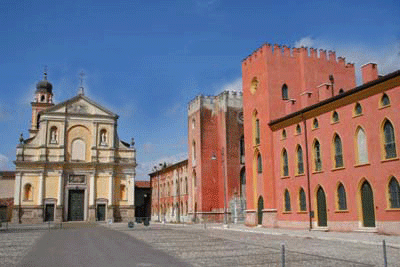
Goito, a municipality in the province of Mantua, with its fractions
Cerlongo and
Marsiletti is located in the agricultural area of the Mantua plateau, is crossed by the
river Mincio and lies precisely on the right bank of the river. It has ancient origins, and the name Goito itself comes from “Goti”, the Goths. The cultural itinerary of this village includes the famous bridge “
Ponte della Gloria” (“of the Glory”) on the river Mincio, the beautiful “angolo della Giraffa”, (“the Giraffe’s corner”), that is a charming mansion with a garden of willow trees that lies on the river bank, and the tower of the medieval castle. For those who love to be in open air, the riverside has been equipped with a cycle and pedestrian track; alternatively, the
Parco Bertone Centre, a beautiful garden managed by the Mincio Park, can be visited.

TERRITORY OF GOITO
Province: Mantova
Fractions: Calliera,
Cerlongo, Maglio, Massimbona, Maioli,
Marsiletti, Sacca, Solarolo, Torre, Vasto
Surrounding municipalities: Cavriana, Ceresara,
Guidizzolo,
Marmirolo, Porto Mantovano, Rodigo,
Volta Mantovana
Altitude: 33 m s.l.m. –
Population: 10.093 –
inhabitants name: goitesi
Goito is a municipality in the province of Mantua, which has about 10,000 inhabitants; important road junction the country is located on the right bank of the Mincio River and is the only town in the center of which it is crossed. Its territory is almost flat and is the most characteristic and due to the idea we have of the Po Valley. Differently colored fields stretching to the horizon depending on the crops, which are divided by a network of canals and ditches that carry the water to irrigate the fields, but also for defining the properties and the different cultures. The soil is rocky and presents with the new systems have been initiated vegetable crops, grapevines, fruit etc.. There is little industrial activity, and has developed the craft (wood, marble, textiles) and employs more than 1,000 employees. There are also many dairies, farms and gravel pits.
HISTORY OF GOITO
The origin of Goito dates back to a period before the rule of the Romans, under whose guidance Mantova became a thriving colony. Interesting archaeological finds have been found Duranti excavations carried out at the end of the last century and the beginning of the current, thus confirming its existence at that time. Its strategic position made of Goito a vital center of union between the left bank and right bank of the Mincio and obligatory point of passage. After the rule of the Goths Barbarian raids continued until the early Middle Ages and the reign of the Byzantines, followed by two centuries of Lombard rule. Goito was a dark period until the arrival of Canossa, who remained for nearly a century and a half. Between the wars, alliances, marriages of convenience, conspiracies and intrigues Goito will be found to be inextricably linked with the Marquis Ludovico Gonzaga. There are many works that can be admired at the time, among them a villa with a garden, the restoration of the Tower, the fortification of the castle, the hydraulic of the waterway and the bridge featured on the Mincio are only part of what they left Gonzaga. Until the end of 1550 under the guidance of Gonzaga was a flourishing period, then the government of the Duke of Mantua Vincenzo quarter marked the beginning of the decline of the Gonzaga Nevers replaced by inheritance from the branch that ended the long period of artistic Gonzaga. With the arrival of French rule and Napoleon Bonaparte began the taxation of contributions, sizes and bullying until again under fire of the Austrians, the lost city of Goito. In 1848, with the outbreak of the first war of independence, the “Bridge of Glory” by Goito there was the first major confrontation with the Austrian troops.
TYPICAL PRODUCTS OF LOCAL CUISINE OF GOITO
Agnoli, fresch egg pasta, tortelli di zucca, tagliatelle with wild game, risotto with tastasal, Mantua salami,